Building LinkedIn Retargeting Audiences From Identified Website Visitors
Identify your known contacts to stop wasting ad spend reaching them twice.
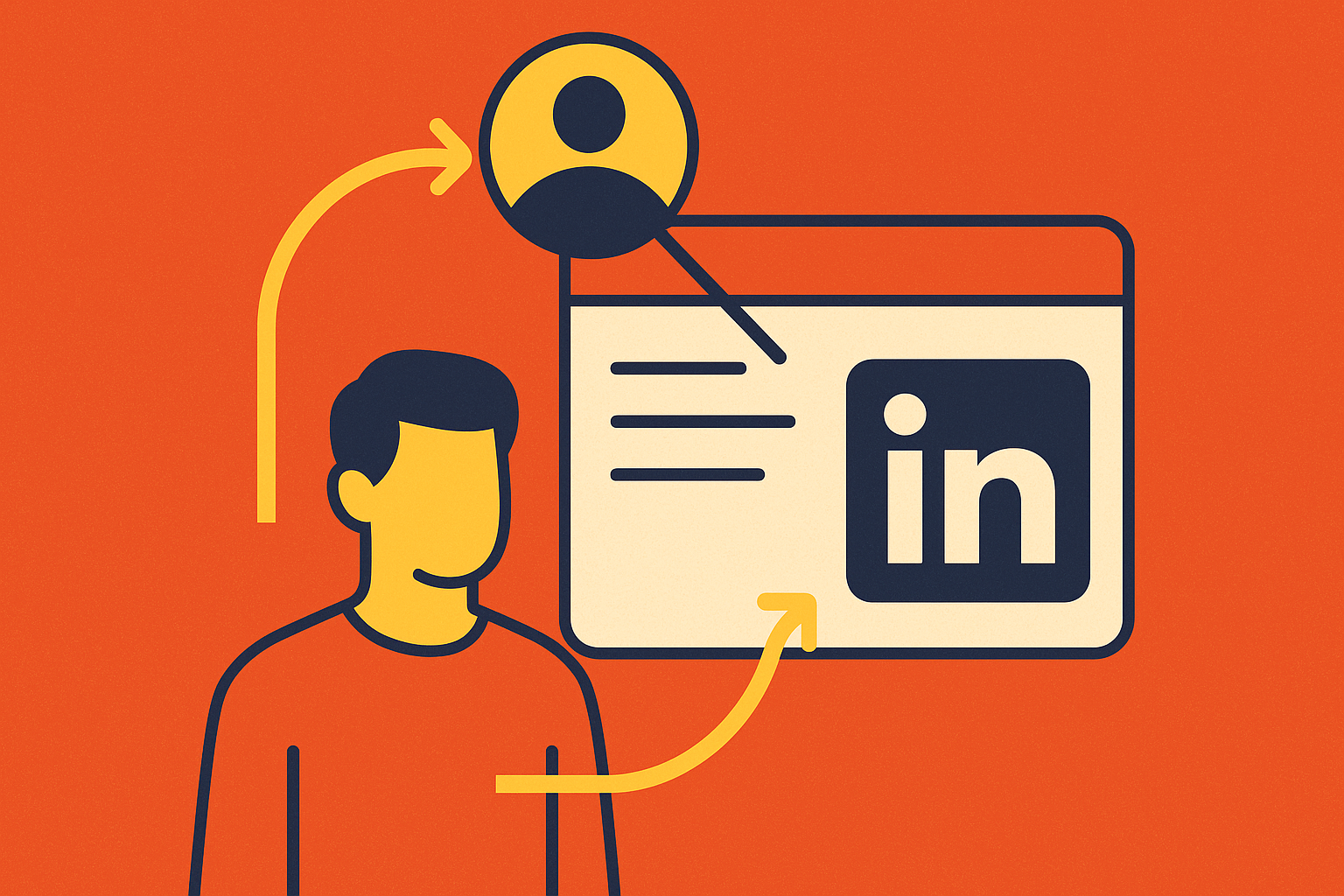
A marketing team installs the LinkedIn Insight Tag, builds a single retargeting audience from every visitor who lands on the site, and starts paying CPM rates to put ads back in front of that pool. Somewhere inside that pool sits a visitor whose email address already lives in the CRM, reachable for the cost of sending a message. The pixel cannot tell a stranger apart from a known contact, so the team pays to reach that person anyway. That is the foundational assumption this piece sets out to challenge: standard LinkedIn retargeting treats every visitor as equally anonymous and equally worth paying to reach.
The Insight Tag fires on every visitor who lands on the page, with no discrimination between a student researching a paper, a job seeker reading the careers page, an existing customer checking a feature, a competitor doing diligence, and a genuine prospect evaluating a purchase. All of them enter the same retargeting audience. Budget gets spent on impressions with no realistic path to revenue, because the targeting logic never asked who these people are before deciding to pay for a second look at them.
Consent gaps, wrong-level capture, and the absence of a quality filter in the pixel itself produce this waste, each one letting money get spent reaching the wrong people. Consent is the first: visitors who decline the cookie banner never enter the audience at all, and that share is meaningful across Europe, so the pixel's picture of site traffic is incomplete before a campaign even launches. The second gap is capture at the wrong level: pixel retargeting remembers the one person who visited, not the finance director, the legal approver, or the internal champion who never set foot on the site but holds a vote in the purchase decision. The third gap is simpler: there is no filter in the pixel itself to screen low-quality visitors out of the pool before money gets spent reaching them. None of this makes the channel worthless. It makes the standard setup a blunt instrument where a sharper one is available.
Building Audiences with LinkedIn's Matched Audiences System
LinkedIn's Matched Audiences framework gives teams more ways to build a retargeting audience than most campaigns actually use, and the first step toward an identity-first strategy is understanding what each of these signals captures on its own.
Website audiences draw on members who visited a specific page, but you need the Insight Tag installed, and the audience needs at least 300 matched member accounts before it activates. Lead Gen Form audiences capture members who opened or submitted a form, with a lookback window selectable across a range up to a year, though form opens and completions do not map directly onto matched member accounts. Conversation ad audiences gather members who opened a conversation or clicked any call-to-action inside it, with several lookback window durations on offer. Company Page audiences include members who viewed the page or clicked a CTA in its header, also with a selectable lookback window. Conversions API audiences let matched CAPI events build a retargeting pool, if member matching succeeds and that same 300-member minimum is met, and this category is built for retargeting and nurturing visitors who already showed interest and sit further down the funnel.
A geographic constraint runs across all of these audience types. Audience size may be limited within the EEA and Switzerland, and LinkedIn will only match members who have opted in to the feature through the consent interstitial or their own ad settings.
What all nine of these signals share is a focus on behavior. They record a visit, a click, a form submission, a view. None of them record who that member actually is in any sense a sales or marketing team could act on directly: no company name tied to a revenue record, no title, no email address sitting ready for outreach. LinkedIn's own audience-building tools describe engagement. They leave identity as a black box, and that gap is where the next layer of the strategy has to operate.
Visitor Identity Enrichment and the Behavioral Black Box
Visitor identity enrichment takes the anonymous behavioral signal that LinkedIn's audience types capture and resolves it into a named individual tied to a company, a title, and a contact detail. That data layer does not exist inside LinkedIn's native tools on its own, and it is the mechanism that makes everything described in the rest of this piece possible.
Identity resolves in tiers. Company-level identification links a visit to a business through reverse IP lookup and comparable signals, and because this method does not depend on cookies, a declined cookie banner does not remove that company from view. Company-level identification is generally treated as compliant under the GDPR's legitimate interest basis set out in Article 6(1)(f), because it does not process personal data the way individual-level tracking does. Person-level identification goes a step further, resolving a visit down to a named individual complete with name, company, title, LinkedIn profile, and email, and it is this tier that makes direct outreach and precise ad-platform suppression possible. Identification methods behind these tiers include form fills, which produce the richest record of all because a visitor who completes a form hands over verified information with no inference required, along with progressive profiling built up across repeat visits and proprietary identity graph matching against first-party and third-party signals.
A geographic limit applies here as well, and it matters for any team operating in Europe. For EU-based visitors, GDPR-compliant tools operate at the company level only, through reverse IP lookup, because that processing runs on a legitimate interests lawful basis. Personal data is not processed beyond that point without a lawful basis such as explicit consent, so person-level identification is not available for those sessions unless that consent exists.
The output of this enrichment process, name, company, title, LinkedIn profile, and email, maps directly onto the data fields that LinkedIn's Matched Audiences and Conversions API already accept for building and suppressing audiences. That alignment is what makes the downstream strategy workable. Platforms performing this work surface that name, company, title, LinkedIn profile, email, and mobile number in real time as visitors arrive on a site, feeding it into the CRM and ad platform integrations that the suppression and segmentation steps described next depend on.
Using identity data to suppress already-known contacts from retargeting audiences
The first and highest-value move available once person-level identification is running is removing identified contacts from the audiences that already exist, because retargeting a visitor whose email sits in the CRM means paying a premium for a channel that performs worse than the free one already available.
The economic logic is straightforward. Once a visitor is identified, direct outreach, whether a simple email or a personalized sales sequence, tends to produce a higher downstream conversion rate than an ad click, at a dramatically lower cost per contact. Retargeting earns its keep for visitors who cannot be reached any other way, not for visitors already sitting in a contact database.
Two implementation paths put this logic into practice. The first is manual export suppression: identified visitor emails get exported from the enrichment platform, uploaded as a contact list to LinkedIn Campaign Manager, and applied as an exclusion audience across retargeting campaigns. It works immediately but needs a periodic refresh to stay accurate. The second path syncs suppression through the CRM: identified visitors route into HubSpot or Salesforce through the enrichment platform's integrations, a dynamic list of those contacts builds automatically, and that list syncs to LinkedIn as a live exclusion audience. This path stays current on its own, so a visitor identified today gets excluded from retargeting without anyone running a manual export.
The CRM-synced path holds up better over time because match rates decay as contacts change jobs or move between companies. A live sync keeps the suppression list accurate without requiring manual intervention to catch up with that decay. Certain segments should be suppressed without exception: current customers, who deserve their own dedicated campaign rather than a spot inside acquisition retargeting, contacts already moving through an active sales sequence, and anyone who has already converted on the campaign's primary goal.
Building intent-segmented LinkedIn audiences from the visitors who remain anonymous
Once suppression removes every visitor who can be identified and reached directly, what remains is the group where LinkedIn retargeting earns its budget: visitors who cannot be contacted any other way. Segmenting that residual pool by intent signal is what makes the spend against it defensible.
Page type visited is the first and clearest signal. Pricing, demo request, comparison, and contact pages indicate active evaluation. Product feature and integration pages suggest active consideration one step earlier in the process. Blog and resource pages indicate early-stage research, when a visitor is still forming the problem. Recency compounds this signal: visitors from the past seven days convert at meaningfully higher rates than visitors from several weeks earlier, and building separate audiences by recency tier allows different messaging and different bids for each. Depth of engagement adds a third dimension, where repeat visits within a short window and extended session duration on high-intent pages carry more weight than a single pageview ever could. Where video is part of the funnel, LinkedIn's video audience tool allows teams to build audiences from members who watched varying portions of an ad, and the 97% completion tier functions as an intent signal strong enough to rival a form submission.
Four segments consistently return the most value once this logic is applied. Pricing and demo visitors who did not convert sit at the top, warmest of the group, and respond best to proof points or a concrete offer. Repeat visitors to product or integration pages respond well to case studies drawn from companies that resemble their own. Blog readers who have also visited a product page sit in a bridge position, where content connecting the research-stage material to a commercial offer tends to move them forward. Visitors who match the company's ideal customer profile on size, industry, and region round out the group, even where their individual-level behavior is thinner than the other three segments.
Company-level identification adds a layer that pixel retargeting alone cannot reach. Once you know the visiting company, LinkedIn's account-targeting tools let you reach its full buying committee, including decision-makers and approvers who never visited the site themselves, so account-based targeting builds on top of the behavioral signal a single visitor left behind. CAPI audiences extend that same logic further still: any server-side event, a CRM stage change, a product trial activation, an offline conversation logged by sales, can become its own audience inside Campaign Manager, letting a team retarget based on where a prospect sits in the funnel.
Why unfiltered bot and AI agent traffic corrupts audience quality
Every step described so far depends on clean traffic data, and that dependency is where agentic AI traffic now poses a real problem. Agentic browsers built to be indistinguishable from a real Chrome session generate enough non-human traffic today to distort both enrichment outputs and retargeting audiences if nothing filters that traffic out before it reaches either system.
Detection has grown harder. Analytics platforms including GA4 cannot reliably tell a real visitor apart from a headless browser or a Playwright script running inside a Chrome-like environment, so these non-human sessions get categorized as real visitors and pass straight into the enrichment pipeline. Some of these agents are not built to self-declare, and for those, browser-layer signals such as TLS fingerprinting, canvas and WebGL fingerprinting, and mouse movement analysis are losing their power to discriminate as agentic systems grow more sophisticated. Network and behavioral signals, ASN reputation, account history, and cross-session behavior patterns, are becoming the more reliable layer for catching what browser signals miss. A practical detection hierarchy combines four signal families to cover this gap: identity signals from HTTP headers and TLS fingerprints, network signals from ASN and IP reputation data, browser signals from script-observable device properties, and behavioral signals from mouse, keystroke, and navigation patterns.
The consequence for a retargeting strategy built on identity is direct. If non-human sessions pass through unfiltered, they inflate audience sizes with entries that were never a person to begin with, reduce match rates against real LinkedIn members, and can cause enrichment platforms to return false company attributions, wasting suppression budget on contacts that never existed and feeding bad data into the intent-segmentation logic built in the previous section. Some platforms address this upstream, detecting and reporting on AI agents such as GPTBot and ClaudeBot, and surfacing what content each one consumes and who operates it. That filtering layer is what keeps the enrichment data and the audiences built from it clean enough to trust.
Closing the attribution loop: connecting LinkedIn ad spend to identified companies and individuals
Everything built so far, suppression, intent segmentation, account targeting, only earns its added complexity if a team can measure whether the identified-company audiences it built actually moved deals forward. Measurement has to show whether a specific company, known to have visited the pricing page, entered pipeline after its buying committee got retargeted.
LinkedIn Campaign Manager's native attribution runs on a last-touch model, and it only counts conversion events you send it within the window you set for each conversion rule. For B2B sales cycles that run through multiple touchpoints before a deal closes, that constraint leaves a meaningful amount of influence uncounted. A native CRM integration now closes part of that gap: Salesforce, HubSpot, or Dynamics 365 can connect to LinkedIn Business Manager and surface data directly in Campaign Manager, showing influenced pipeline and revenue at the company level, with a data-driven attribution model available as an alternative to last-touch. That connection is what makes account-level targeting defensible to a finance team evaluating the spend.
CAPI closes the remaining piece of the loop from the server side. By sending CRM stage changes, offline deal events, and pipeline milestones directly to Campaign Manager as conversion signals, a team can attribute LinkedIn ad influence to outcomes that never produced a trackable click, the late-stage deals that last-touch models systematically undercount.
Put together, this setup lets a team report more than cost per lead. It can show influenced pipeline by company, cost per account reached within the ideal customer profile, and the difference in conversion rate between the suppressed-outreach path and the paid-retargeting path for the same visitor cohorts. That last comparison answers the question suppression raised in the first place: whether direct outreach actually outperforms paid retargeting for the visitors a team can already identify. Measuring both paths separately, on the same cohort, is the only way to know for certain, which is what an identity-first LinkedIn strategy is built to make possible.
Sources
- Retargeting with Matched Audiences
- Matched Audiences - Overview - LinkedIn
- LinkedIn Matched Audiences
- Get started with LinkedIn website retargeting
- Matched Audience Usecases - LinkedIn
- Website Visitors Retargeting - LinkedIn
- Website Retargeting - LinkedIn
- DataDome Report: Malicious Automated Traffic Is Growing 9x Faster Than Human Traffic — and Targeting Deeper Into the Customer Journey