When Not to Contact an Identified Website Visitor
Knowing who visited your site doesn't mean you should contact them yet.

Identifying a website visitor is the starting line. Whether contact advances a deal or damages a relationship depends on the visit context, behavioral depth, job function, CRM status, and traffic source. The practical task is to distinguish an actionable buying signal from a recognizable person who has given no reason to expect a sales conversation.
Why identifying a visitor is not the same as having permission to contact them
Visitor identification can surface a name, title, company, LinkedIn, email, and phone number from an anonymous session without a form fill. Company-level identification maps an IP to an organization, while person-level identification combines an IP with an identity graph to surface a likely individual. The distinction is consequential because person-level matching is probabilistic. A small but real share of identified contacts therefore represent misattributed sessions before questions of intent or suitability even arise.
The strongest argument for immediate contact is urgency. Buyers research independently, and the window for a useful conversation can be narrow. But reaching someone before they meet the qualifying criteria may still miss that window. It can poison the relationship before it starts and reduce the prospect’s willingness to engage later. A working email address gives a way to reach someone, but the other signals must show whether contact now would help them with the buying process.
When the visitor is almost certainly not a human buyer
A resolved company name does not establish that a person visited the site. Non-human traffic can map to real organizations through real IP ranges, so company-level identification signals can look as though they point to buyers. These are false positives for sales purposes. AI crawlers and LLM agents, competitive intelligence bots, and job-candidate research tools can all bring traffic that has no purchase intent, as can automated activity tied to security research. Contacting the apparent organization wastes effort at best and exposes irrelevant targeting at worst.
AI-driven crawler and agent traffic has grown sharply, while most AI agents do not self-identify when visiting a site. As a result, they can pass through standard identification pipelines without being flagged as non-human, although advanced multi-layer detection methods can distinguish them. The number of matches alone therefore says little about their quality. When a tool fails to separate these sessions, the resolved company may be the crawler’s operator.
The practical requirement is to establish that the traffic is human before acting on an identified session. There is no sales-intent question to resolve for a crawler, regardless of the apparent company fit. Removing those sessions also prevents their activity from being read as account engagement. Once a session is established as human, geography and legal standing become the next prerequisites for any outreach decision.
When geography and legal standing make outreach precarious before it begins
Person-level identification is largely limited to U.S. traffic in practice, and extending it to European visitors creates legal exposure under GDPR. An anonymous visit on its own does not give consent. Company-level IP resolution is generally permissible under the legitimate interest basis in Article 6(1)(f) when it is cookieless, processes only business rather than individual-level data, is disclosed in a privacy policy, and has a documented Legitimate Interest Assessment. Resolving a European session to a named individual typically requires consent that the session does not provide.
That distinction is not a blanket prohibition on business outreach. A personalized message to a business decision-maker may be permissible under legitimate interest when a documented assessment supports it, the message is business-relevant, an opt-out is offered, the sender is identified, and the contact details came from public sources. But national rules can be stricter, and ePrivacy rules in Germany and Poland may still require prior consent. A cold email referencing a website visit that the person never consented to disclose does not straightforwardly satisfy the legitimate interest conditions.
GDPR enforcement has led to large fines for sending commercial emails without valid consent, transferring prospect data without a legal basis, and continuing to email people after they asked to unsubscribe. Geography must therefore be a prerequisite filter. Even a human U.S. session with clean legal standing can come from someone whose existing relationship makes cold outreach the wrong choice.
When CRM status signals that reaching out now would be redundant or damaging
CRM integration is a precondition for responsible visitor-triggered outreach. The relationship lookup must precede the Slack ping or sequence trigger. An existing customer, an active opportunity, and a recently churned account each need a different response from a net-new prospect. Without that distinction, identification can cause a team to treat an established relationship as an introduction.
Existing customers may visit product pages, help documentation, or pricing to conduct routine research, explore expansion, or evaluate renewal. None of those activities warrants a cold sequence that treats them as strangers. Active opportunities also already have a salesperson who owns the account. A parallel automated approach creates message conflict and signals organizational disorganization to the buyer. Recently churned accounts require account-specific judgment because dissatisfaction from the past several months may remain unresolved, and generic outreach can inflame it.
The CRM record itself also needs scrutiny. A contact record older than roughly a year may no longer reflect the person’s role, company, or status. The enrichment data needs to be checked again before anyone acts on a stale record. Effective workflows explicitly filter and route by CRM status before outreach fires, which requires configuration in most tools. Even after that lookup establishes a net-new prospect with clean legal standing, the visit may still argue for waiting.
Behavioral signals that indicate research, not readiness
A single top-of-funnel session often leads to outreach too soon because identification makes someone who is just reading content look like a sales prospect. Someone who reads a blog post or general overview without looking at pricing, use cases, or product detail is still learning the basics. The company may be a perfect fit for the target profile. That fit does not turn a brief introduction to the subject into readiness for a sales conversation.
Even a pricing-page visit needs context. Low scroll depth and a short session make a single visit a weak signal, despite the page’s apparent proximity to a buying decision. Returning across multiple sessions, scrolling deeply into pricing or comparison content, and then viewing case studies is a materially stronger pattern. Pages viewed, time on site, scroll depth, and click patterns together make the event journey more informative than an isolated identification ping.
Other journeys point away from buying altogether. A job candidate who looks through career, team, and about pages may create an account signal without any purchase intent. A known competitor’s employee mapping the product landscape is another reason to withhold contact, particularly when the CRM already identifies the company as a competitor. A record containing page views, video plays, exit intent, and form interactions supports these distinctions, while a company name alone does not. Yet even a close look at the product cannot show that the person doing the research is the right contact.
When the identified person is the wrong contact at the right company
Firmographic fit and strong engagement do not guarantee that the identified individual can influence or approve a purchase. Contacting the wrong person can create friction and alert the account that its activity is being tracked. The name and email therefore need to be read with seniority, job function, and ICP-fit classification before they become outreach inputs.
A junior visitor on high-intent pages may be doing background research or acting as an internal champion before a decision-maker gets involved. Immediate contact can surface the vendor before that person has built internal support. This is a timing and targeting problem. That activity may show that the account is interested, even if the visitor is the wrong person to contact first. Holding the account for a higher-seniority signal can be more appropriate than converting the session directly into a sequence.
Function is as important as seniority in this judgment. Reaching someone in IT when the decision sits in finance, or a practitioner when the budget holder is a VP, can force a conversation with someone unable to advance the deal. That person may also route it away from the right stakeholder. Enrichment can help identify the appropriate contact where account fit and behavior justify further qualification. Before that judgment is complete, however, the traffic source can change the meaning of the engagement itself.
When the traffic source reveals that the visit was not self-directed buying research
A paid ad click is not necessarily a stronger buying signal than an unpaid visit. Someone who arrives from a broad awareness display or social campaign is responding to an ad that interrupted them and may not be doing active research. The distinction changes the outreach decision. A firmographic profile that supports contact after organic pricing-page traffic does not provide the same justification after a brand-awareness ad click. The visitor’s route to the site supplies context that on-site behavior alone cannot show.
Referral traffic can produce a similar ambiguity. A press article, podcast mention, or industry newsletter may lead someone to look into a company out of curiosity. Retargeting introduces a different problem because the visitor is already part of a paid media audience. For example, a retargeting click followed by an independent cold sequence places paid advertising and sales outreach around the same visit without coordination. That can create message conflict and obscure attribution between the ad spend and the sales motion.
A click from an email campaign is also part of a marketing sequence already under way. Independent sales contact can fragment that relationship and trigger opt-out behavior from both channels. When source data is linked to identified records, it also shows which ad platforms and campaigns bring in ICP-fit companies and individuals, helping close the paid-media attribution loop. After these signals are read together, the response must fit the visitor.
Building a routing logic that matches the signal to the response
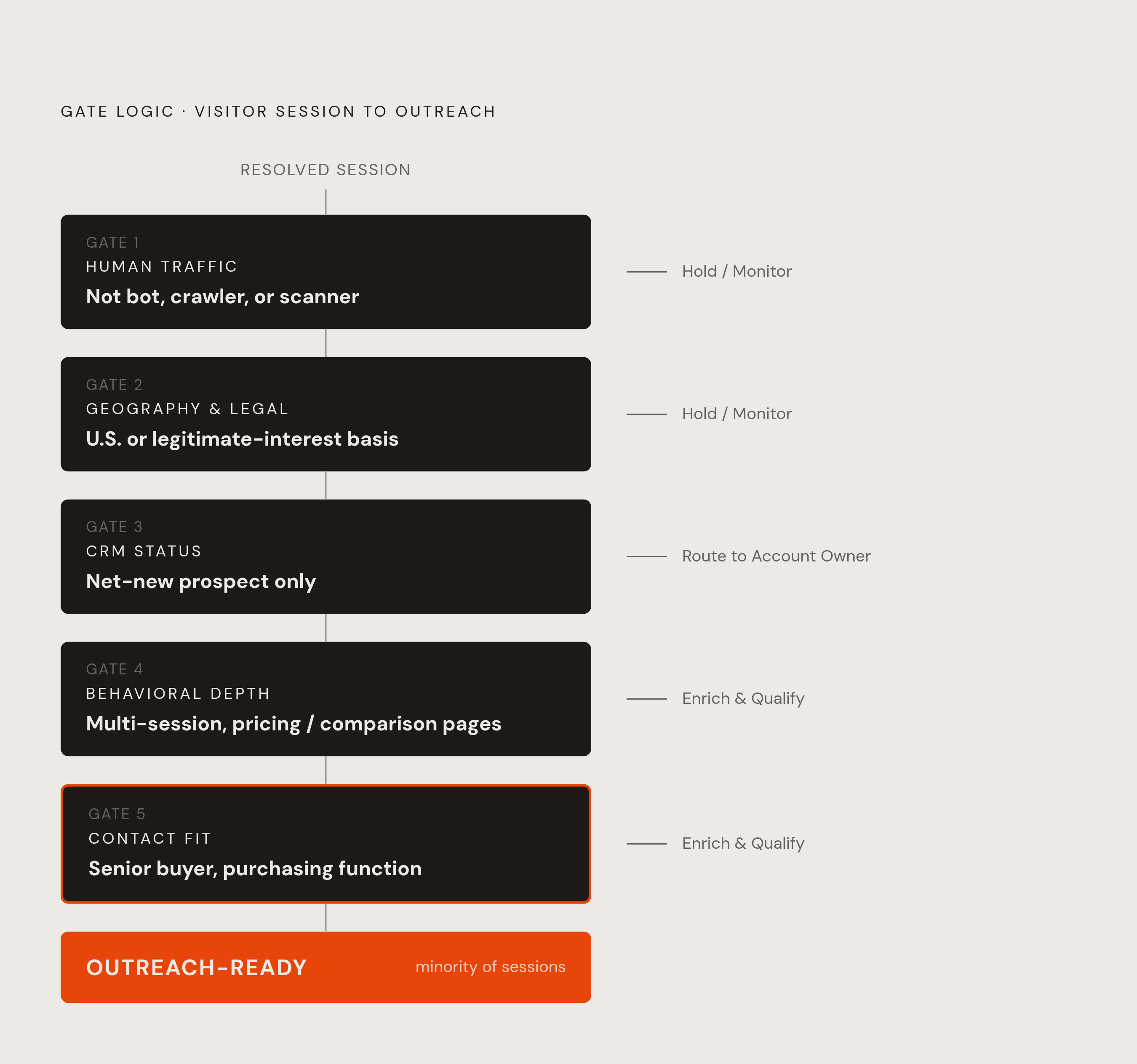
The practical framework is to treat human status, geography, CRM status, behavioral depth, job function, and traffic source as simultaneous filters. They are not a checklist whose completion automatically authorizes contact. Non-human traffic and unresolved legal standing prevent a session from becoming an outreach opportunity, while the remaining signals determine its appropriate route. The result should be a response category supported by the full record.
Hold and monitor fits a qualified company whose visit is early-stage, whose identified person is junior, or whose source suggests non-evaluative intent. A watch list preserves that signal without triggering outreach. Route to account owner applies when the company is an open opportunity or existing customer, with the visit context sent to the assigned rep. Recently churned accounts need a decision based on their own relationship before they go back into prospecting.
Enrich and qualify fits a net-new ICP-fit company with substantive behavior but an unverified or low-seniority contact. The right person needs to be found before outreach fires. Outreach-ready is a narrower category. It combines a net-new ICP-fit company, a senior contact in the buying function, deep engagement across multiple sessions, organic or direct traffic, no active paid retargeting conflict, and clean CRM status. That profile warrants immediate, personalized contact.
Automation depends on the record containing more than identity. CRM status, seniority classification, the event journey, and traffic source must reach the appropriate Slack alert, CRM task, sequence trigger, or watch list. Identification establishes the starting line, and routing determines when to run.