The Match Rate Formula That Actually Predicts Pipeline Not Vanity Traffic
Separate person matches from company hits to measure real pipeline potential.

Website visitor identification match rate is the share of a defined traffic pool that a tool resolves to a company or person. Vendors report different percentages because they count different traffic and different kinds of matches. A pipeline-predictive rate must instead count accurate, ICP-fit person matches as a share of human sessions, then use intent depth to tell which reachable contacts are ready for sales attention.
Why the match rate number on a vendor's pitch deck is not the number that fills your pipeline
The match rate on a vendor’s slide measures resolved traffic, while the number that reaches your CRM needs to represent people sales can pursue. An advertised “80% match rate” may describe company matches, leaving the claim that 80% of visitors become named, reachable prospects unsubstantiated. Without that distinction, the percentage promises a volume of sales-ready records that the underlying data does not support.
The distortion begins with the denominator. One vendor divides resolved sessions by all sessions, while another includes only B2B sessions on corporate IPs. A restricted denominator can leave difficult-to-resolve traffic outside the calculation, so its result cannot be compared directly with a rate calculated across the whole site.
The numerator creates a second source of ambiguity. A vendor can count a company-level hit and a person-level hit as equivalent successes, although they give sales different information. A team buying on that combined figure is evaluating resolution volume.
How do website visitor identification tools calculate their match rate percentage?
Tools calculate their percentage by dividing the traffic they resolve by the traffic they include, but resolution operates at two distinct layers. Company-level identification uses reverse-IP lookup to match a visitor’s IP address to a registered business. The returned record contains firmographic information about that business. It answers which account appears interested, without establishing which employee visited.
Person-level identification works on a different object. It cross-references IP, cookie data, and device fingerprints against identity graphs and enrichment databases to surface a named individual. That record can include a title, email, and LinkedIn profile. Instead of identifying a business associated with a connection, it seeks to identify the person behind the visit.
The layers answer different questions, have different legal issues to weigh, and give teams different records to work with. Two vendors can therefore report the same-sounding match rate while measuring success against entirely different objects.
That distinction also separates identification from contact enrichment. Visitor identification builds a record from an anonymous signal, whereas enrichment fills gaps in a person record already held. Their starting points differ. A percentage describing successful enrichment cannot stand in for the rate at which anonymous visitors become known people.
Why company-level match rate predicts account awareness, not pipeline
A company match establishes an account-level signal. Even a correct match does not show which employee visited, whether that person holds purchase authority, or whether sales can reach them. Those gaps remain after the lookup succeeds.
This does not make company data useless. Account-based programs can use it when reps already know the stakeholders and need a signal that a target account has appeared. In that setting, the account record supplies context for an existing sales motion.
A pipeline-oriented numerator has a stricter job. It must distinguish addressable buyers from correctly identified visitors who do not belong in prospecting, including competitors, recruiters, and existing customers. Raw company match rate counts these as successes because the resolution itself is correct. Yet none establishes a new prospect merely by appearing on the site.
Accurate small numbers can be more useful than large anonymous counts. Nine real, known product-tour viewers provide a firmer basis for follow-up than a larger pool whose identities remain unknown. The relevant distinction is whether the record contains enough reliable information to support the next sales action.
How AI agents and bot traffic silently corrupt the denominator
Every unresolved bot session included in total sessions increases the denominator without adding a potential buyer to the numerator. That pushes the calculated rate down. When identification credits are spent on those sessions, the same contamination also consumes budget without creating pipeline potential.
DataDome’s Galileo Threat Research Team reports that 80% of AI agents do not identify themselves when visiting a site. User-agent string matching therefore misses too much of this traffic when used on its own. Behavioral analysis, ML fingerprinting, and network-level signals are needed to address traffic that does not announce itself through headers.
Filtering has to precede the rate calculation. Otherwise, a vendor may give a precise percentage based on a mix of buyers, other human visitors, and automated traffic. The number looks definite, but its denominator does not represent the audience the revenue team intends to measure. Bot exclusion is consequently part of the metric’s definition.
An honest filtered result is not necessarily a lower percentage. Removing unmatched bots from the denominator raises the rate if the numerator stays unchanged, while excluding non-human activity reduces the volume of traffic eligible for consideration. The comparison therefore needs both counts and percentages.
The formula components that actually map identified visitors to pipeline
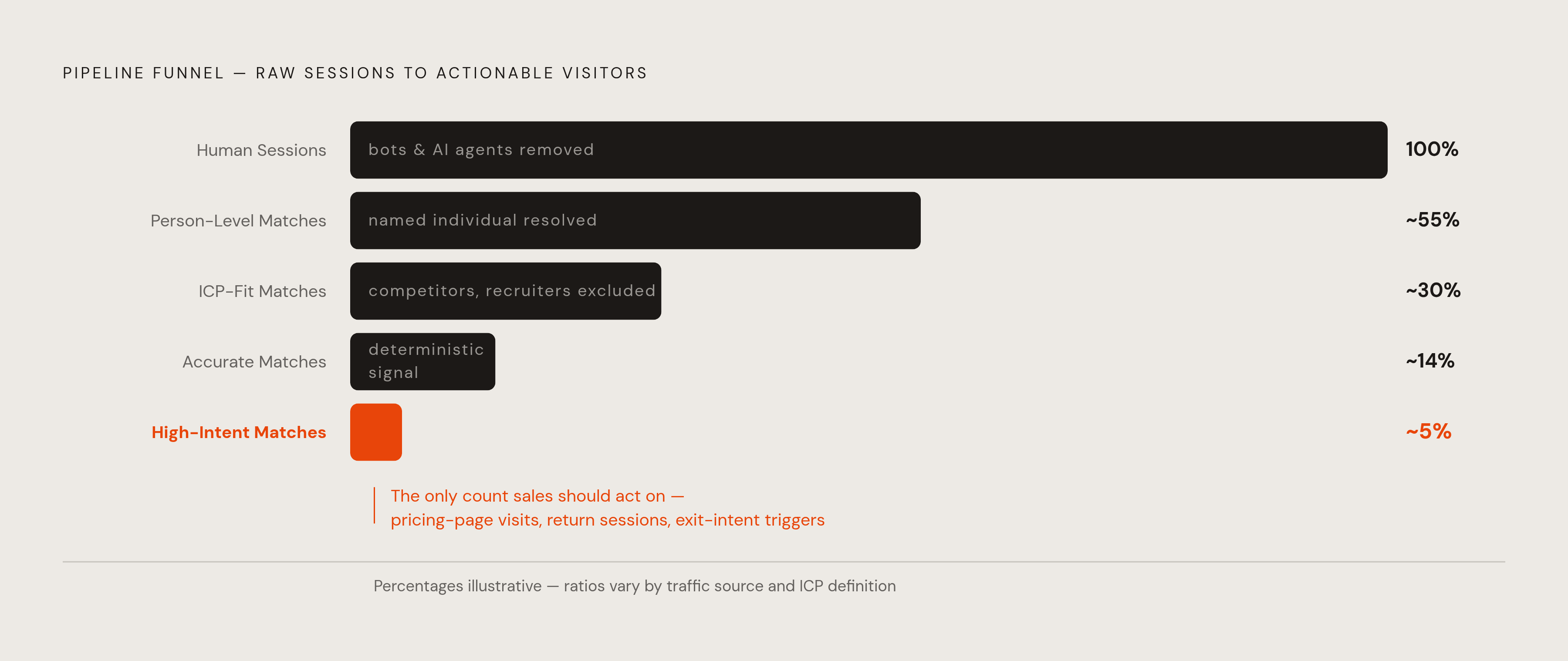
The formula begins with the human-session count after confirmed bot and AI-agent sessions have been removed. That is the denominator for measuring how much relevant traffic the identification process converts into usable records. The next input is person-level resolution, reported separately from company resolution. A combined rate cannot supply this input because account matches do not establish named contacts.
ICP fit then narrows the person matches. An accurately identified visitor outside the addressable market remains a successful identity match, but does not become a prospect for that reason. Dividing ICP-fit person matches by clean human sessions produces a useful intermediate “survival rate.” It describes the fraction of human traffic that has passed both identity resolution and market-fit screening.
Accuracy is a separate filter. Match rate measures how much traffic receives an identity, while accuracy measures how often that identity is correct. A named record cannot support reliable outreach if the person has been misidentified. The formula must therefore account for correctness before treating resolved, ICP-fit visitors as sales candidates.
Intent depth supplies the next qualification. A visitor who viewed the pricing page three times in a week offers a different signal from someone who loaded the homepage and bounced. Page-level engagement, scroll depth, return visits, and exit intent help distinguish those behaviors. An intent threshold helps sales set different priorities for people who have been correctly identified.
The chain starts with human sessions and applies person-level match rate, ICP fit rate, accuracy rate, and the share meeting the intent threshold. Its output is pipeline-eligible identified visitors. Using average opportunity rate and deal size links that count to what those opportunities could be worth. Keeping those conversion inputs explicit prevents an identification percentage from posing as a revenue forecast.
How intent depth and engagement signals sharpen the formula beyond identification
A high-intent record changes what a rep knows before opening a conversation. A name and email provide a contact, but a record showing return visits, pricing-page views, and engagement with solution content provides a reason to prioritize that contact. The event trail supplies the context. It turns an otherwise generic approach into follow-up informed by the visitor’s actual activity.
The useful record goes beyond a single identification ping. It can contain high scroll depth on solution pages, video plays of demo or case-study content, exit-intent triggers, and visits to a form without submission. Along with return visits within a short window, they give sales more detail to judge who is ready.
However, engagement does not establish buyer eligibility on its own. A known competitor who looks into pricing can give a strong behavioral signal even though sales should exclude them from prospecting. CRM-status context must therefore filter intent against known non-buyer categories, including existing customers, competitors, and recruiters. Otherwise, the formula rewards activity that should have been suppressed.
The workflow needs to pair realistic identification with first-party capture and a five-minute follow-up. Speed is only one part of that combination. The behavioral trail helps sales tailor the response, while the qualification filters keep the focus on visitors who are a good fit for prompt follow-up. Without that workflow, even an accurate, high-intent record can remain an unused contact.
Where paid media attribution connects to the formula and why most teams miss it
A pipeline-eligible record still leaves an important question unanswered if its traffic source is missing. Sales may know whom to contact and what that person viewed, but demand generation cannot connect the visit to the campaign that acquired it. Attribution closes that upstream gap. It links the quality of identified visitors to the spending that produced them.
Many identification tools surface a name and send a Slack alert without recording which Google, Meta, or LinkedIn campaign brought that visitor. The alert supports follow-up, but not a campaign-level budget decision. A team can see that identification worked without knowing which paid activity deserves more investment. The formula then measures useful results without linking them to the cost of bringing in those visitors.
Traffic source is therefore a required field in a pipeline-predictive record. Attribution needs to connect the identified company and individual to the ad platform and campaign. That connection allows the ICP-fit layer to inform spending decisions. Campaigns can be assessed by the pipeline-eligible matches they produce.
This changes what counts as acquisition success. A campaign that attracts traffic is not necessarily attracting people who survive the identity, fit, accuracy, and intent filters. When those results can be traced to their sources, the team can reallocate spend toward channels producing suitable prospects.
What to ask a vendor before accepting their match rate as a pipeline input
The practical audit consists of seven questions, beginning with the denominator. Ask whether the rate includes all sessions, only B2B sessions, or only sessions on confirmed corporate IPs. This establishes the scope of the claim. It also exposes whether degradation from remote work is reflected in the percentage or screened out through the choice of traffic pool.
Second, ask how bot and AI-agent sessions are excluded before the denominator is calculated. The answer should distinguish header-only user-agent matching from behavioral analysis and ML-layer fingerprinting. Detection method belongs in the metric discussion. Without it, the vendor has not established that its denominator represents human traffic.
Third, ask for company-level and person-level match rates separately. A blended percentage cannot serve as the person-resolution input. Fourth, ask whether the tool can filter identified visitors for ICP fit and screen out known non-buyer categories.
Fifth, ask what share of matches are correct and how correctness is established. The evidence should distinguish deterministic events, such as an email click or authenticated session, from probabilistic inference. Coverage alone is insufficient. A vendor needs to explain both how often it returns an identity and the basis for trusting that identity.
Sixth, ask which intent signals come with each identified record. A full event journey with pages viewed, scroll depth, return visits, and exit intent lets teams qualify visitors in a different way than a single ping does. Seventh, ask whether ad platform and campaign attribution are recorded per visitor and can flow into the CRM. That determines whether the same record can inform both outreach and budget allocation.
A vendor willing to answer all seven is almost certainly presenting a smaller, more honest pool of pipeline-eligible visitors than its headline match count suggests. That smaller number is the useful pipeline input. Acceptance should depend on whether its denominator, identities, fit, accuracy, intent, and acquisition source can withstand inspection.