Exit-Intent Signals for Re-Engaging B2B Visitors
Identify departing B2B visitors by person and CRM status, not anonymous behavior alone.

Exit-intent signals can help re-engage B2B visitors only when they reveal enough about the departing buyer to support a sales action. The useful shift is from anonymous popup triggers to person-level identification and routing, with behavioral history, buyer context, and CRM status attached to the event.
Why exit-intent signals fail B2B sales teams when they stay anonymous
Kissmetrics's exit intent guide describes how detection relies mainly on the cursor moving up toward the browser chrome. More sophisticated implementations also track rapid scrolling toward the page top, tab-switching through the Page Visibility API, and cursor movement toward the back-button area. These behaviors fire a JavaScript trigger at probable departure. The mechanics detect movement while leaving the buyer behind it unidentified. That distinction limits what sales can do with the resulting event.
Sona's B2B exit intent evaluation guide explains why a discount popup does not fit a B2B buying process that takes time and follows several threads. A visitor who is leaving may have spent three months in a six-stakeholder evaluation, looked at pricing many times, and compared features across sessions. Yet an anonymous exit gives sales no person to contact. Most website visitors never submit a form, so even high-value prospects can leave without entering a sales workflow.
What B2B decision-stage behavior actually looks like before the exit moment
Advancelytics's intent detection framework identifies repeated pricing visits, plan comparisons, feature comparison loops, return visit density, and proof validation as decision-stage signals. Each reveals more than a page-view count. Repeated pricing visits show that the visitor keeps looking at plans, while moving between product pages shows that they are reviewing what the product can do. Returning across sessions and resuming that review gives the sequence continuity. Case study consumption and ROI validation add evidence that the visitor is testing the purchase against business needs.
The useful distinction is between browsing and evaluation. A system reading these patterns should distinguish whether the visitor is evaluating, hesitating, or ready to buy. Someone who leaves after repeated comparisons and proof review presents a different intervention target from someone who arrives, glances, and leaves. Exit handling should therefore take into account what the visitor does in this session and has done in past sessions, along with where the cursor is. Without identity resolution, however, this rich evidence remains detached from the human evaluator sales needs to reach.
The three tiers of visitor identification and what each one can actually tell sales
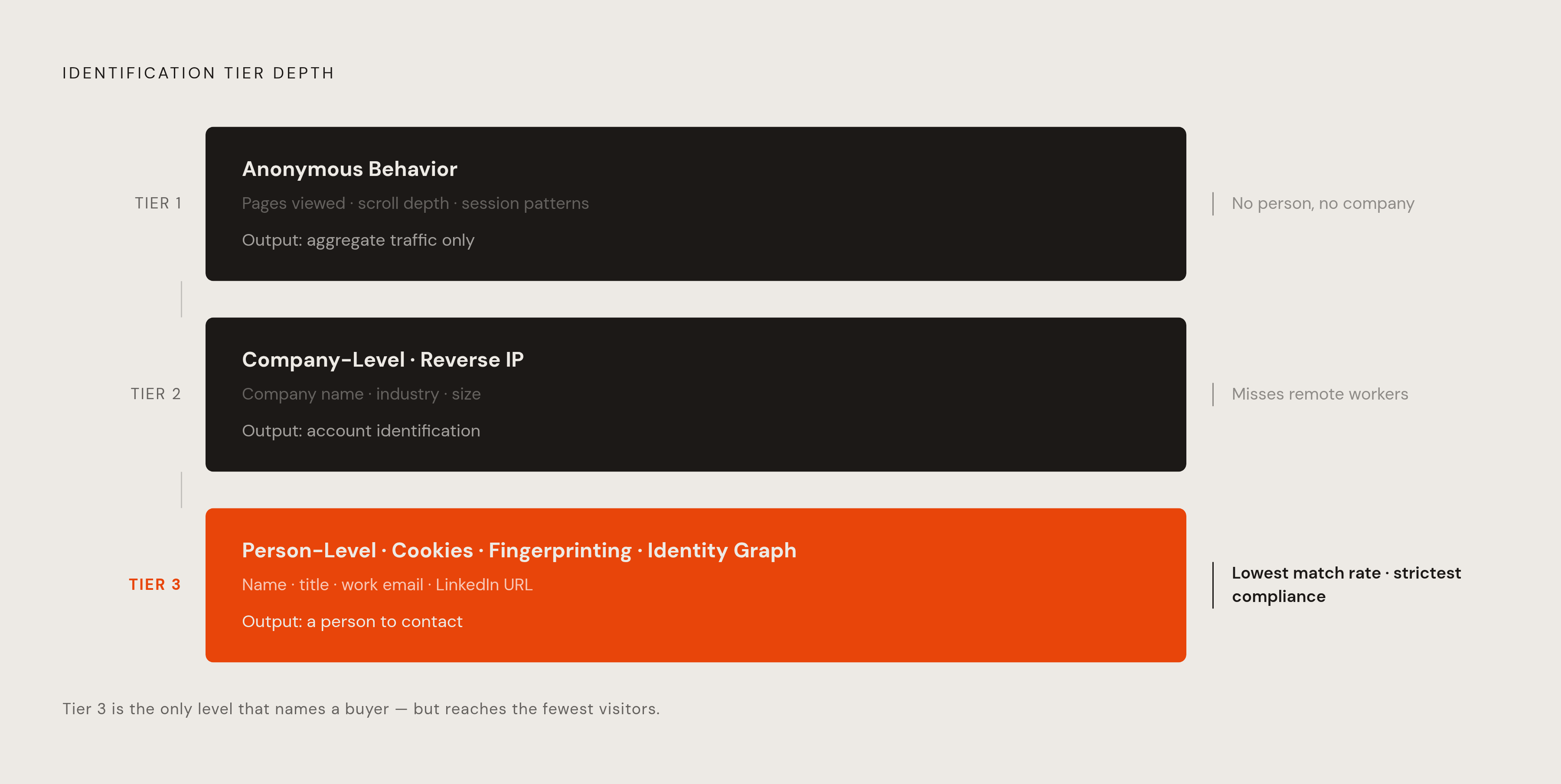
The first tier records anonymous behavior, including pages viewed, repeat visits, session patterns, and scroll depth. It covers traffic without establishing who produced it. Sales receives aggregate evidence. This is the behavioral foundation for identification, but it cannot support person-specific follow-up after departure.
The second tier finds the company behind the visit by using reverse IP lookup to check databases of corporate network ranges. It can supply company name, industry, and size. Its reach is limited to a minority of total traffic, chiefly corporate office traffic, because remote workers on residential ISPs do not resolve through that method. Company identification supports account-based marketing alerts, such as notification that Salesforce visited a pricing page. It still leaves the SDR guessing who visited. Account context improves relevance, but an organization is not a contact.
The third tier resolves a person through first-party cookies, device fingerprinting, and cross-referencing identity graphs built from opt-in professional data. The record can have the person's name, title, work email, and LinkedIn URL. Its match rates are materially lower than company-level rates, accuracy is primarily associated with US traffic, and compliance requirements are stricter. This tier adds the person to the account and behavioral foundations.
Why vendor match rate claims cannot be trusted at face value
“Match rate” can describe coverage, resolution level, or accuracy. Coverage measures the share of visitors receiving any identification. Resolution level distinguishes a company name from a named person with contact details, while accuracy asks whether the identification is correct and complete enough to use. These are not interchangeable measures of performance. A high company-coverage figure and a lower person-level accuracy figure do not establish which tool will produce more workable leads.
AI agents and crawlers inflate raw visitor counts, so a published figure that does not separate them from human sessions cannot establish human identification performance. Buyers also need to know whether the reported outcome is merely a resolved company or a contact a rep can use.
The reliable test is a pilot using the team's own traffic and consent configuration. A rep should review a sample of identified accounts against what they know about those accounts and count the records that are both correct and useful. The better selection frame is what the tool resolves, which regions it covers legally, and whether it writes to the CRM in a shape reps will act on.
What a person-level exit record actually contains and why the fields matter
A workable exit record begins with name and job title so the SDR knows whom to address and whether seniority matches the ideal customer profile, or ICP. Company and firmographic data let teams score a record before they route it. A LinkedIn URL lets the rep quickly check who the person is and may offer a warm way to reach them, while a business email, preferably on the company domain, lets the rep make contact without further enrichment. Traffic source and ad platform connect the visit to its paid or organic origin.
The full event journey adds page views, scroll depth, video plays, form interactions, and the exit moment. Visit count and prior session history distinguish a first-touch departure from a repeated evaluation, while an ICP fit flag separates priority records from noise. CRM status establishes whether the person is a known contact, an open opportunity, or a net-new prospect, preventing a customer from entering a cold-outreach sequence. A LinkedIn profile sent to Slack is only a notification. A person-level journey with email, phone, pages viewed, ad source, and CRM status gives the rep the context needed to proceed without another round of research.
AI agents visiting B2B sites — a new category of exit signal that most tools misread
Not every evaluation sequence comes directly from a human browser. AI browsing agents can research and shortlist vendors for buyers, creating exit events that look like human traffic. Their purpose distinguishes them from training crawlers such as GPTBot and ClaudeBot, which consume content without representing a buyer in a decision process. These categories require different treatment from identification systems.
GA4 automatically filters declared bots on the IAB/ABC Spiders & Bots List. However, GA4 and most visitor identification platforms categorize undeclared AI agent traffic, including agentic browsers running headless Chrome, as human sessions by default. Browser automation can therefore distort the apparent human audience. It can also hide a useful buying signal. When an agent is shortlisting vendors for a real buyer, identifying the company or person that deployed it gives the departure commercial context that an anonymous exit lacks. Separate detection and classification preserve human match-rate integrity while allowing buyer-directed agent activity to receive its own treatment.
Routing exit signals into sales workflows — what the integration layer must do
Sona's guide sets out three minimum integration requirements, which are bidirectional CRM sync, real-time rep alerts, and paid media audience delivery. Salesforce or HubSpot sync must check existing contact and opportunity status before routing, then write back to the existing record. Slack or Teams alerts need to tell the rep enough to act without opening another dashboard. For visitors who cannot be person-identified, audience delivery to LinkedIn, Google, or Meta supports retargeting without a manual export. Identification alone does not move the record into a workflow.
Custom workflows also need access to the underlying events. HMAC-signed webhooks for identified person events and activity events let engineering teams send data downstream without polling a dashboard, and API delivery lets them build a custom integration. CRM status then determines the destination. A net-new ICP visitor leaving pricing can enter an SDR sequence, while an open opportunity leaving a competitor comparison page goes to the account executive with that context. When a current customer leaves pricing, the event may go nowhere or trigger a CS alert.
Attribution connects these actions to the spend that produced the visit. Exit events associated with Google, Meta, or LinkedIn campaigns let teams distinguish ads that reach genuine evaluators. That context also supports suppression of wasteful retargeting to existing customers or accounts too small to convert. The integration layer must therefore pass on the contact name along with both buying context and acquisition context.
Evaluating exit-intent and visitor identification platforms for B2B use
Sona's guide identifies five evaluation dimensions, namely detection accuracy, account identification depth, CRM and marketing stack integration, personalization by buyer journey stage, and privacy compliance controls. It describes detection accuracy and CRM sync as commonly underweighted. Getting the identity right does not fix duplicate CRM records, just as an integration that works well cannot fix a wrong identity. Evaluation should test the complete path from detection to action.
The criteria also need to account for traffic classification and record depth. A platform should separate AI agent traffic from human sessions in its match-rate reporting and attach the full event journey to person-level identification. CRM status awareness should be tested against existing contacts and customers as well as net-new records. Data access through API, webhook, and MCP lets action proceed without a person opening a dashboard.
Sona's guide presents Sona as an account-based intent and pipeline activation platform with intent score, buying stage, custom signal triggers, ICP scoring, and Salesforce and HubSpot integration. It is a representative purpose-built B2B option that requires validation on the buyer's traffic. The practical evaluation is a two-week pilot. The team should sample identified person records and have a rep count those that are correct, complete, and actionable without additional enrichment. That count establishes the usable identification outcome under the team's actual traffic and consent conditions, rather than a vendor's headline definition of a match.
Treating exit behavior as a routing event rather than a popup trigger
The strategic question is not how to stop every visitor from leaving, but how departure can begin a sales motion. Leaving is not itself a buying failure. For a person-identified, ICP-matched, decision-stage visitor, the event should prompt a CRM creation or update with behavioral context, an SDR alert that supports personalized outreach, and paid retargeting audience inclusion, with classification establishing whether the activity came from a human buyer or the buyer's agent. Sona's guide describes first-party exit signals as more accurate and immediately actionable than third-party intent aggregated from external publisher networks because they are real-time, site-specific, and tied to session history. Their value is realized when the exit becomes a person-level routing event.